sábado, 19 de marzo de 2011

ESASHI OIWAKE. THE OLD TRADITIONAL SONGS FROM THE NORTH OF JAPAN

THE TOWN OF ESASHI
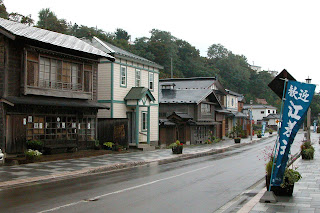
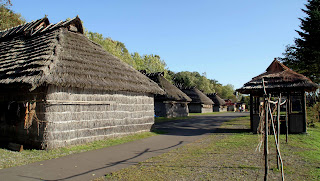
Here were is the ESASHI OIWAKE (one type of japanese traditional songs) started. Esashi is a relatively small town located in the southern-west of Hokkaido. To go there from Hokadate (main city in the south of the north large island of Hokkaido) you have to take a local train from Hokadate. It takes 2-3 hours. In the main street you can visit a temple and see antic houses made of wood. The view of the harbour is quite nice. If you are not in Esashi during the festival (see below), the most interesting thing in the town is the small Museum of Esashi Oiwake, 15-20 min downwards on foot from the station. You can also visit Herring baron's houses (nishingoten) that they may still be seen in the shoreline. Some of them, such as Yokohama House and Nakamura House can be visited.


Station of Esashi. A local train stops there.
It is nice not always to travel with shinkansen (faster train)


The harbour


Wooden Houses in Downtown

Japanese settled in Esashi more than eight Centuries ago. The population is about 13,000 people. The relevance of this small town is why it was the place of birth of one of the best known "and hidden treasures" of the Japanese folk melodies: Esashi Oiwake.

ESAHI OIWAKE
This type of folk traditional songs originated in Nagano Prefecture, in the main island of Honshu, where it was sung by horseman (mago-uta) and it was spread throught Japan in the Edo Period. Once cross the sea and arrived in Esashi, in the north island of Hokkaido, the melody was modified and enlarged. The lyrics also changed. Instead of describing horsman's life in the mountains, they sang about the nature, the sea and fishing. The Esashi Oiwake has been transmitted to next generations for over 200 years. Two instruments usually accompanies to the singers, a flute (shakuhashi) and a 3-stringed lute (shamisen), in almost a free rhythm. The song "Esashi Okiage Ondo" (Esashi offshore fishing song). It is a fisherman's gwhich describes going herring fishing and returning to port. The sonf "Esachi Mochitsiki Bayashi (musical cccompaniment to rice cake pounding). These and other songs are designated Important Intangible Hokkaido Folk Cultural Property. http://www.hokkaido-esashi.jp/oiwake/english.htm.


FESTIVALS
Oiwake singers meet in Esashi once a year, in third weekend in September. It is held since 1963. They sing for two days the tunes of Oiwake tradition and a competion is organized. http://www.hokkaido-esashi.jp/three_festivals/english.htm


In Esashi is also held the Ubagami-Daijingu (shrine). Similar festivals or Matsuri are spread Japan during the year, specially in summer. The origin of the festival was to apprecite a bumper of herring fishing dating back to 360 years ago. There is a large parade around the town with people carrying a shrine, dressing in traditional clothes and playing the shakuhashi or shinobue (flutes) and taikos (drums). It is usually held in the second week of August http://miyatake-k.blogspot.com/.

They also celebrate the Doba Shishimai Dance. It has three acts, a Shinto ritual dance of three fawns, a pestle-swinging dance and a dance of hinds quarreling over a fawn. http://www.hokkaido-esashi.jp/oiwake/english.htm

ESAHI OIWAKE MUSEUM
In the town of Esahi there is a small museum about Oiwake. It is posible to listen to old recordings with headphones, to buy Oiwake CDs (very rare even in Japan) and see a performance of Oiwake by three musicians (a singer and two players of instruments, the shakuhashi and the shamisen). Performances are at 11 am, 1 pm and 2.30 pm. The have a unique large collection of 10 tapes/CDs of Oiwake songs for selling.


Entrance of the museum
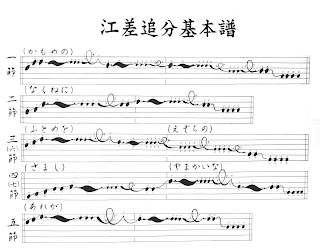
Sheet Music from the museum
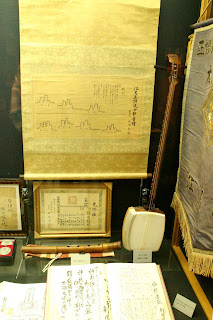

Shamisen and Shakuhashi from the museum

Performance in the Museum of Esashi

INTERNATIONAL RECORDINGS
In my knowledge, there are very few recordings of CDs of Oiwake songs in the international market. In some folk colections of traditional japanese folk songs, sometimes it is possible to find an oiwake song.

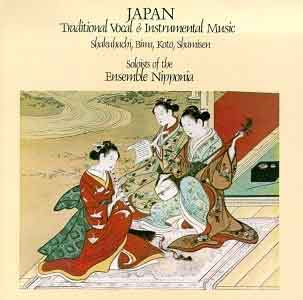
Ensemble Nipponia - Japan: Traditional Vocal & Instrumental Music
1976 Explorer Series. In this album there are traditional songs. A representation of Oiwake is shown with the song entitled Esashi Pack-horseman's Song. It is very good album an one of the first of japanese music to be released on in international market. the Nonesuch series released several CDs of japanese traditional music in 2008, most of them were re-edition with different jacket.

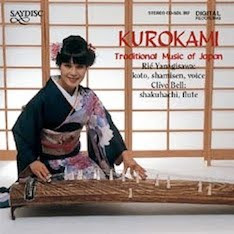
Rie Yanagisawa. Kurokami. Traditional songs of Japan. There is koto, shamisen, voice and Clive Bell plays the shakuhachi. It was released in England by Saydisc in 2005. There is one exmaple of Esashi Oiwake. it can be dodownloaded from amazon.co.uk.


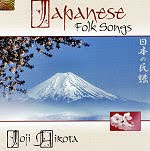
Joji Hirota. Japanes Folk Songs. Released by Arc Records in England. He is from Hokkaido. The ARC album was released in 2007. His album The Gate, in 1999, has a song song entitled Esashi Oiwake. For my taste, this album is over-arranged and and orchestred.

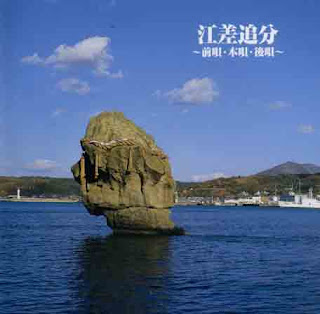
The song of Esashi Oiwake. Rhymes to prominent people of Hokkaido. This CD is the best one that I know. It was released by King Records in 2003 in the collection "Best Selected Library". Reference KCw 8628. I think it was produced in 1983. In relation with the others albums that I mentioned, this album is only Esashi Oiwake songs, and there is no other traditional songs from Japan. In addition you can listen the "pure" voices of the singers with her caracteristic way of singing. Wonderful touches of shakuhashi and shamisen in the songs made the album very enjoyable. It is a delicious shivering album for the senses and heart!!!. A jewel!!.
If you want to listen short examples of Esashi Oiwake music on-line I recommend to visit page of the "International Shakuhashi Society" written Dr David W. Hughes and Clive Bell. There are examples of shakuhashi music played by musicias such asTanigushi Yoshimubo, Koga Masayusi, Takahashi Kosui, Kikuchi Tansui and Clive Bell http://www.komuso.com/pieces/pieces.pl?piece=1837.


Note: Japan comes to my mind again after the earthquake of 11th-March-2011. So, I decided to write this small chapter of Oiwake music. In this date, Japan suffered a large earthquake near to the north-east coast. It was followed by a tsunami and a serious damage of Fukushima Nuclear Power Plant, which is one of the largest stations in the world. From the Nuclear Plant a leak and release of radiation went to the atmosphera. Japanese have a strong sense of community, those who loose their houses remain with order and friendly in the shelters run by volunteers. Surprisely, crimes like looting don't ocurr and lines for food are respected. My admiration and support for this great country.



martes, 30 de noviembre de 2010

NEPAL: BEAUTIFUL MUSIC and LANDSCAPE

GEOGRAPHY
Nepal is located in the Himalayas and bordered to the north by China and to the south, east, and west by India. The north of the country has eight of the world's ten tallest mountains of the world. The highest is Mount Everest. Another famous mountain for its relatively short trekkings is the Mount Annapurna. The south is fertile and with much more habitants. Thus, the population density is high in the valleys and very few above 2,000 meters. Nepal has approximately 30 million people, whom about 50% live below poverty line.
The capital is Kathmandu, nowadays with a lot of traffic and quite polluted. In the metropolitan area there are 1.5 million inhabitants.
The religion practiced by a larger majority of people is Hinduism. However, there is a minority of people such as Sherpa and dholpas, who practice the Buddhism.
The main income and jobs comes from agriculture (tea, rice, corn, wheat, sugarcane, milk, and water buffalo meat). There is little industry which is related on the processing of the agricultural products. Tourism is another source of income (beautiful landscape, historical buildings, some easy trekkings and also high mountains for serious climbing). In the last decade the number of shops in Katmandu has suffered a strong increase. Even some international companies are now present in the main streets. The Thamel area of Katmandu is crowded door-to-door of hostel/hotel and souvenirs shops, who sells jewllery, cloths, religious items and many copies of antiquities. In spite of this, the rate of unemployment (and underployment) is very high (46%).
http://www.indexmundi.com/nepal/unemployment_rate.html. Therefore, many people have to emigrate, mainly to India; the Gulf countries and Malaysia.

PEOPLE OF NEPAL

The Nepalese are descendants of three major migrations from India, Tibet, and North Burma and Yunnan via Assam. There are about 90 different races and tribes.
The largest groups can be divided on the basis of geographical locations by altitude.

http://www.visitnepal.com/nepal_information/people.php.

1) Alpine Based Cultural Groups. High Himalayas
Sherpa people. It means people of the east in the Tibetan language. Originally the come from Tibet. They are Buddhist
Dolpa people. They live west of the Kali Gandaki river valley, in the high mountains. They are Buddhist.
Larke and Siar people. Larke are living in the northern most part of Nepal's Gorkha district while Siar is the northern part of the Dhading district. They speak the Tibetan and Gurung languages and have ethnic affinity with Gurungs.
Manang bas. The people of Manang are called Manang Bas. They live close to the Annapurna. They have their own language and scripts.
Lhopas. Live in the Mustang areas. They practice the Buddhism. They have their own local language and festivals.
Olangchung people. These people are the inhabitants of Olanchung Gola, the main trading route along Eastern Nepal
Other ethnic groups within Nepal's alpine region are: Thudam, Topke Gola and Lhomis.

2. Temperate Zone Based Cultural Groups. Middle Hills and Valleys
Brahmin and Chhetris.
They ancestors came from India's present Kumaon, Garhwal and Kashmir regions. In Nepal are distributed in scattered patterns all over the country, which are considered the two highest castes in Nepal. They follow the Hinduism religion. They are divided into two major streams, the Purba and Umai. The Kumain people are of the origin of Kumo, Northern India, Uttar Pradesh. They speak Nepali, the national language of Nepal and use a script with basis in Sanskrit.
Kirati People. They mainly consist of Rai and Limbu people. Literally Rai or Limbu means headman. They are descendents of the Kirati's who first formed the kingdom in the Katmandu Valley. They now mainly live in far eastern Nepal. Kirati people are well known for their courage and bravery and are often recruited into armies abroad (Gurkhas). The religious text of Limbu is the Mundhum.
Newars. They mainly settled in Kathmandu Valley. They have Mongolian features and their own language and script, Newari, believed to have its origin from Tibeto-Burmans. Hinduism and Buddhism are their main religions.
Tamangs. In Tibetan language Tamang means horse traders. They originally came from Tibet. The majority of Tamangs live in the hills surrounding Kathmandu Valley. Their social practices and customs are based on Buddhism and they have their own language, Tamang.
Magars. They live in hill areas of western Nepal. Their religion is Buddhism and their language, Magar Kura, depicts their affinity to the Tibeto-Burmese tongue and culture.
Gurungs. They are mostly settled along the higher slopes of the Annapurna areas and the Kali Gandaki river above the Baglung district. They love music and have their own language. The Gurung and Magar people lives in the west, and their origins comes from North Burma, Yunnan and Tibet.
Thakalis. The origin of Thakali is Thok Khola, a high valley in central Nepal along the Muktinath region. They have Mongolian features, a fair complexion and narrow eyes. Thakalis are divided into four major groups: Gauchan, Tulachan, Sherchan and Bhattacan. Their religion is a mixture of Buddhism, Hinduism and Jhankrism.
Occupational castes. Certain ethnic groups in Nepal are categorized according to their occupation. They are Kamis (smiths), Damais (tailors), Dhibis (washerman) Sarkis (cobblers), Gaines (professional singers) and Khumbharas (porters). The origin of these castes has not been investigated yet by the anthropologists. Hinduism is their major religion and Nepali their major language. Many have their own local festivals and practices.
Furthermore, Sunwars, Jirels, Chepangs, Kusundas and Panchgaule (five villages) are other minor ethnic groups of the Nepal midland hill regoins. Sunwars are Jirels are considered to be the off shoots of Magars. Panchgaule are similar to Thakalis. Kusundas still live in primitive conditions. They live in caves, under trees and in temporary huts in the forest. Only a handful of them are settled into occupational farming. Chepangs, who are believed to be the offshoots of Kirats, are slowly moving into urban areas.

3) Subtropical Based Cultural Groups. Ethnic Groups of Terai Region and Southern Nepal border
Brahman and Rajputs.
These people are similar to Bramin and Chhetris of the middle hills. Their are influence from the neighboring North Indian people.
Tharu. They live in the southern Tetai region. They follow the Hindu religion and their practices are dependent on many typical Aryan practices. Danwars, Majhis and Darais are very similar to Tharus, physically and culturally. Nevertheless, they speak their own languages which are of Sanskrit origin.
Rajbansis. This is a dominant ethnic group of far eastern Terai areas of Jhapa and Morang. Although they follow both Hindu and Muslims religions, they have their own local practices.
Satars. They are similar to Santhals of Bihar, India. They are very much like Tharus and their social life is organized and disciplined. They believe in Hinduism. Dimals, Bodos, Dhangars are agriculturist Hindu. Bodos are settled in an area know as the Mechi Zone and are more known as Mechain people. Dhangars, who live in one part of the eastern Terai have their origin in Madhya Pradesh, India. Dhimals are the Terain counterparts of the Limbus from the eastern Terai, mainly in Jhapa.
Musalmans. There are Muslims migrated from Northern India. They speak Urdu and their social practices correspond with the Muslim religion.


The major language is Nepali, which is the official language (48.61%). Other languages are Maithili (12.30%), Bhojpuri (7.53%), Tharu (5.86%), Tamang (5.19%), Newari/Nepal Bhasa (3.63%), Magar (3.39%), Awadhi (2.47%), Rai (2.79%), Limbu (1.47%), and Bajjika (1.05%). Dialects of Tibetan are spoken in and north of the higher Himalaya where standard literary Tibetan is widely understood by those with religious education. Many Nepalis in government and business speak English as well. Local dialects in the Terai and hills areas are unwritten, although attempts to conver in systems for writing many in Devanagari or the Roman alphabet.

FOLK MUSIC OF NEPAL

The modern world has also arrived in Nepal. The canadian singer Bryan Adams played in Kathmandu in 2011, being the first international rock musician who play in Nepal. Pitifully, electric guitars, large set of drums, electric bass and hip-hop are now played by many young musicians. I could heard pop and rock music in Katmandu, with many extra-decibels to hidden the lack of virtuosity. Also there is a strong influence of the indian music. Folk nepali music is in danger due to the lack of interest for the youth and the paucity of musical schools.

Traditional Newari Music . It developed from medieval era in the Katmandu Valley. One of the dominant forms of traditional Newar music is Dapha, which are devotional songs based on classical ragas. Dapha music is played by bands known as 'Dapha Khalah' that may be associated with a traditional groups called 'guthi'. According to the ragas certain songs are played at certain season or time of day. The Newari Music orchestra consists mainly of percussion and wind instruments. String instruments are very rare. Paahan chare music is probably the fastest played music whereas the Dapa the slowest. There are certain musical instruments such as Dhimay and Bhusya which are played as instrumental only and are not accompanied with songs. The dhimay music is the loudest one. In the hills, people enjoy their own kind of music, playing sarangi, madal and flute. They also have many popular folk songs known as lok geet and lok dohari.

Other Indigenous Nepali Music
Khas music.
In the Khas society traditionally, castes like Damai, used to play a number of instruments for occasions such as marriage. The minstrels, gaine, used to play instruments like Sarangi but this music and the Gaine are gradually declining.
Gurung Music. The gurung have very rich tradition of music and culture. Gurung have established the system of Rodhi which is little similar to mordern discos, where young people meet and share their views in music and dancing. They have own music and dancing history. Some musical dance like Ghatu, Chudka are still in existence.In many gurung villages they are still performing such type of musical dances. These dance are performed either in a solo or in a groups.In few gurung villages one can still find such dances or music.
Kirant Music. The Yakthungs (Limbu) have various forms of dance, songs and musical instruments. Of them, Dhaan Nach (paddy dance) and Dhol Nach (drum dance) are popular symbolics. Rais celebrate Sakela and Sakewa which are also known as Chandi Naach. Many form of their dance involve rituals or religious offerings towards Mundhum (native Kiranti religion). Traditional dance and songs are also practiced for weddings, festivals or simply gatherings.
Tamang Music. Tamang community is well known for Damphu, traditional instrument. Tamang selo music is based on the usage of Damphu and Tungna. Western and Indian instruments are also found in some modern Tamang Selo music.
Magar Music. Salai Jo and Sorathi are the two unique and exclusive musical genre of Magar music. Other folk music and instruments can be found between the sherpa and people of tibetan origen. They use to play a six-stringed named dramnyen. They can be heard in the Himalaya mountains, but sometimes also in Kathmandu in the Bodnath tibetan area.

Dohori. It is unique genre of song in Nepal and in the world. Dohoro means from two side, or a debate. This debate is in rhythm, and involves quick and witty poetry. The two teams in Dohori usually involves boys in one group girls in the other. The song is started with a question usually from the boys side. The girl follows the question with a quick response and continues the musical conversation. Dohori songs can last for long time. The length of the Dohari depends on the quick thinking ability of the players. Some Doharis have lasted as long as seven days. People celebrate the entire night singing the Dohari. They start singing in evening and end at dawn. Love and marriage are usually the topic of the debate. The male expresses his love or feelings to the girl in the song and girl may or may not respond positively for various reasons.


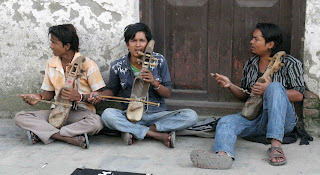
Street musicians playing the sarangi in Kathmandu

FOLK MUSICAL INSTRUMENTS OF NEPAL

There literature about the musical instruments of Nepal is very scare. Since Nepal has many ethnics, also there are many kind of genres and musical instruments, which are spread through the country. If you stay in Kathmandu, most of the non-musician people they do not know the different types of music in Nepal and the indigenous names of the musical instruments. So, for the foreign it is quite difficult to get an idea of the music and musical instruments of Nepal. To my knowledge the main publications about of folk musical instruments of Nepal are the following:


1) Subaru Ram. Cultural Musical Instruments of Nepal Valley. It is of the playing techniques and a few tales of membranophones Dhimay, Dhah, Paschima and Nayakhin; the mostly played musical instruments in Newar culture and societies. Moreover, the book contains introduction and playing patterns of other musical instruments which accompany the above musical instruments.


2) Surat Thakur. Himalchal ke lokwadhya (Folk musical instruments of Himalaya). It is written in Hindi. 1996


3) Ballinger, Thomas A, Harsha Bajracharya, P. Nepalese Musical Instruments. Southwestern Journal of Anthropology 1960; 16: 398-416. University of New Mexico, Alburquerque, 1960.


Music Museum of Nepal


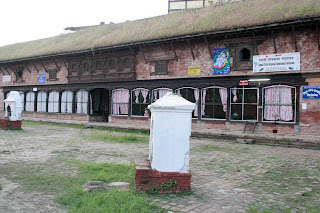
Nowadays, if you want to have an idea of the musical instruments of Nepal, you can visit the Music Museum of Nepal. This Museum is not in any guide book. Do not try to find the address in Lonely Planet or even to ask to a Nepali tour operator. They don’t know it. If you ask to a taxi driver or a tuk-tuk they have no idea where it is located. If you plan to go, check his web http://www.musicmuseumnepal.org/


From Durbarg Square (the main square of Kathmandu), just go south following the main street, and about 24-30 min on foot, you will find a wide street. Then, turn right and it is located in a narrow street in the south side of the street (at Mahadev Bahal, Tripureshwor). It is close to Shiva temple (this is what it says in his web, but most of the people doesn’t know the temple).
If you stay in Kathmandu you won’t loose more than one hour to go and visit the museum. So, do not miss it if you like the traditional music. If you can go on Saturday morning, you will enjoy some of the concerts organized by the museum with small groups or local musicians.
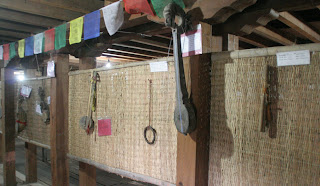
This Museum was created by Mr. Ram Prasad Kadel with the help of the Government, who in 1995 started to make his own collection of Nepali folk musical instruments in an attempt to preserve the instruments and music of Nepal. During all these years, he has collected about 350 musical instruments from Nepal (and some others countries, mainly from India). In the Museum, although small, there is rotational exhibition of about 150 musical instruments. Check the video of this link to get a good idea of the museum. http://suprememastertv.com/es/ajar/?wr_id=309&page=7&url=link2_0&eps_no=1055&show=ajt&flag=0.


MUSICAL INSTRUMENTS OF NEPAL
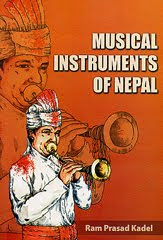
To the short list of publication in Nepali Folk Instruments, now it has been added the wonderful book entitled MUSICAL INSTRUMENTS OF NEPAL written by Mr. Ram Prasad Kadel. He has made the enormous task to compile more than 350 instruments of Nepal in one book with drawings and explanations. There is a version in Nepali and another one in English. Only 100 books have been edited. If you are interested you can buy directly to him. But, please pay in advance!. The book also explains the ethnic people who play the instrument or in which circumstance is used. If you visit the museum Mr. Ram Prasad Kadel is very kind and will explain you about the musical instruments of the exhibition.


Jacket of the English version of the Book


He also published a short edition of the book of nepali musical instruments, which is distributed in the Nepali schools in order to keep the tradition of music and musical instruments
Mr. Ram Prasad Kadel is now working in a PICTURAL ATLAS OF MUSICAL INSTRUMENTS OF NEPAL. He has been taken pictures of many buildings, statues, paintings through Nepal. In a mid-term it will be published. He also is writing an anthropological book explaining the diversity of ethnies of Nepal.


Saturday Concerts in the Museum


Every Saturday the Music Museum Nepal organizes a Folk Music Concert. The event is live telecasted from Radio Mirmire FM 89.4 from 1 pm to 2 pm. If you stay in Kathmandu on Saturday, it is possible to attend the event, which is held at the Museum Nepal on the second floor. Check it before to go there. Some of these concerts have been edited in CD that can be bought in the museum (also by mail). He has published seven CDs with a simple black & white jacket but with great music. A a set of 10 postcards of drawings of Nepali Folk Musical instruments can be also bought in the Museum.


Jackets of the 6 CD's recorded on the Saturday Concerts. The First CD is included in the book Musical Instruments of Nepal


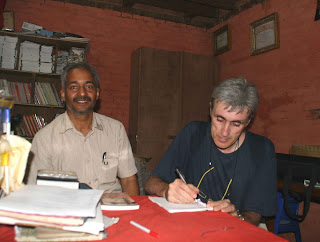
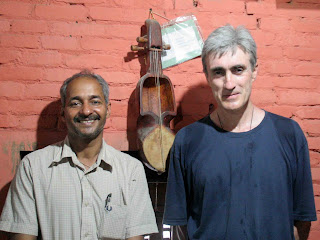
Mr. Ram Prasad Kadel and the author of the Blog


SUMMARIZED CLASIFICATION OF THE MOST COMMON
MUSICAL INSTRUMENTS OF NEPAL
There is a large quantity of folk musical instruments in Nepal, about 200 (some authors even says 400). However, sometimes are quite similar, but with different names or shapes, depending of the ethnic group who is playing it. Nepali Musical instruments are usually used for dancing, in ceremonies and festivals. The traditional indian classical musical instruments, such as sarod, sitar, tambura and tabla are not mentioned. Below the most important folk musical instruments played in Nepal according to the classification of Sachs- Hornbostel system are listed:
http://www.asiarecipe.com/nepmusic.html

1. Membranophones
-Dhimay. It double membrane drum made from a cylindrical hollowed tree trunk with leather pads at both ends. The size is about 20" in length and 16" in diameter. It can also be made of brass. The membranes are played with the hands or using a stick with a pigtail shape in the distal extreme. There is two sizes:: bigger Ma Dhimay and smaller Dhahcha Dhimay or Yalaypoh Dhimay. It is the most common musical instrument amongst the Newars. It resembles the Chyabrung of Kirat Rais and Dhola of Tharus. The dhimay is played in almost all ceremonial marches by the Jyapus.
-Damaru or KantanDabDab. Small double membrane drum used by monks and in Mohani Festival.
-Dhah. It is similar of the dhimay,
-Dholak. It is a double membrane drum, which resembles the Dhah in structure and its playing techniques are similar to that of Paschima. It is played in Dhalcha Bhajans and also accompanies Bansuri. It is usually painted in green, yellow, and red colors. It has ropes with rings to tune the membranes.
-Paschima or Mridanga. It is a double headed drum with is possible to tune. It usually is accompanied with Baboocha (thinner cymbals), Tah (thicker cymbal), Muhali (shwam) or Bansuri (flute).
- NayaKhin. It is mainly played in ritual by the Khadgis. It is also played in funeral processions it is also known as 'Seeh Bajan' (funeral drum). It is similar to Dhah but it is smaller. It is constructed from hollowed tree trunk of an average size of 14" length and 7" diameter.
NayaKhin may be accompanied with Chhusyah and Kaha (Seeh bajan) or by Tah is also and Muhali (Gunla bajan)
-Nagara. This a kettle drum played with two sticks. It is also known by the purans as Dundubhi, Dundhu, Dundhub, Bheri and Adamber. It is often played in pair, known as Joh Nagara. Nagara is also played in Panchai Baja as Damaha. It is too played in Mahakali Dance. It is accompanied with Chhusyah and Muhali.
-Daha. It is tambourine played in Bansuri Bajan or Khin Bajan. It is also used whilst singing songs and in Bhajans.
-Madal or Magah Khin. Two membrane drum with tuning paste at both ends. It is played mainly by magar people and in Newar folk music.
-Dhyangroy. It is a wooden frame drum with goatskin drumheads. It has a carved wooden handle with sea dragon head. It is employed by faith healers and shaman to invoke the spirits of the heavens. It is stroken by a curved cane beater.

2. Idiophones
-Bhusyah. It is a pair of cymbals. They are usually placed in devotional songs (Bhajans).
-Tah. It is also a pair of cymbals, thinner and smaller than the Bhusyah. It is made of Asta Dhatu (an alloy of eight holy metals). It accompanies Dhah, Dapha Khin, Paschima, Koncha Khin, Naya Khin (when played as Gunla Bajab) and others
-Baboocha. It is thinner than Tah, however, it is bigger in size. It is also made of Asta Dhatu. It accompanies Dapha Khin, Pachima, Koncha Khin, Dholak and others.
-Chhusyah or Sichhya. Chhusyah resembles Baboocha but is bigger in size. It accompanies Naya Khin, Nagara and others.
-TainNain. It is a gong, which I splayed a stick. It accompanies Dhimay.
-TiniMuni. It is made of a steel rod bent in the shape of a triangle. It is played by striking with another steel rod. It is played in Dhalcha Bhajans.
-Gan. It is bell played in ceremonies ( eg. Shradh, Janko, Ihi)
-Ghunguru. Ankle Bells
-Binayo. Jew’s harp made of bamboo or wood. Used by Kiranti people.
-Murchunga. Jew harp made of iron and it produces the sound like Binayo and it is played by Kiranti people.

3. Chordophones
-Tungana. It is a folk guitar. Very common, especially in northeastern of Nepal. The body it is carved from single piece of wood. The box resonance has a goatskin. The strings are played with an attached plectrum.
-Sarangi. The folk sarangi has four strings. The classical one it has also sympathetic about 12 strings with pegs on the right side of the neck.
-Ektare. It is a lute with only one string and a round resonance box.
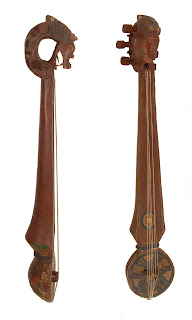
-Piwang/Piwancha. It as a fiddle with two or three stringed instrument. It is played with an arrow and the resonance box is rounded. It is especially played by jyapu (Newar farmer). It has been extincted. A similar instrument it is played by the people who lives in the Tibetan border.


4. Aerophones
-Nekoo. It is a horn instrument.
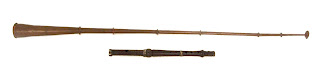
-Ponga. A brass Long wind instrument
-Sankha. It’s a shell. It is used by monks
-Muhali. It is a conical bore shawm, which is played by Jugi caste
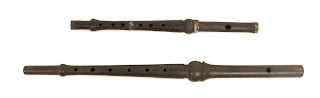
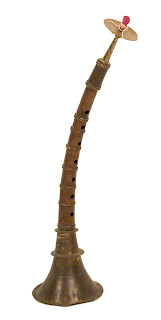
-Bansuri. Bamboo transverse flute. There are different pitch and kinds. The most common are Ghor, Majhawala and Teep, producing low, middle and high tones
-Phaamuka. Three bamboo pipes f the Limbu ethnic group.


Mr. Ram Prasad Kadel and the author of the Blog


Below are shown some examples nepali folk musical instruments owned by the author of the blog.


Tungana (or tungna)


jueves, 19 de noviembre de 2009

HOKKAIDO. The Revival of Ainu Music

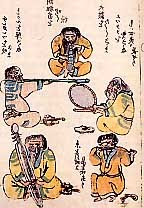
Hokkaido is the large island in the north of Japan. It is connected with the main land by a train under the sea. The Ainu is the indigenous people of Japan that live in Hokkaido. They used to live in the Sakhalin islands north of Japan, the northern part of Honshu on the main island and the Kamchatka Peninsula and on the Kurile Islands of Russia.


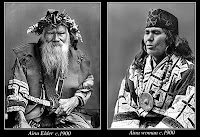
http://bibliodyssey.blogspot.com

It is not clear which are the origins of Ainu people. There are many theories surrounding the origins of the Ainu, but the most popular is that the Ainu were descended from the Jomon people, a hunter-gatherer society who lived throughout Japan about 13000 years ago. They probably came from Siberia or from the southern Pacific. A Caucasian and mongoloid origin as also been proposed.
Ainu people were colonized by the Japanese until Meiji-era. The Ainu attempted several unsuccessfully revolts during the Edo period. Finally, they were forced to an assimilation process, being ordered to adapt to Japanese dresses, ethics and agriculture as well as they married with Japanese people. In addition, their lands were confiscated. The assimilation policies were so successful that nowadays almost nothing remains of the Ainu’s traditional way of life. The most of their traditional dresses, tools, and musical instruments are now only seen in museums.

http://blog.japundit.com/archives/category/japanese-history/.

There is not a national census of Ainu people that lives in Japan. The estimated number that identified themselves as Ainu is about 24,000, although probably there are more. Due to the intermarriage between Japanese and Ainu people, the number of pure blood type Ainu people is very small. Pure blood Ainu have physical characters that are quite different of the Japanese people. They have a larger eyebrows and nose than Japanese people. In addition, they have more body hair. In former times they used to wear a large beard and long hair.

http://www.freerepublic.com/

In relation to the language, there are several theories of the origen of Ainu language: a Siberian (Altaic), southern Pacific, Caucasian and a mongoloid origin as been proposed. In addition, existed several dialects but with no system of writing. However, Ainu language has been transcribed to katakana and Russian cylliric. Nowadays, there are very few people (about 100), usually old people, that speaks their native language. In fact, it is endangered language, that it could extinct in the next generation. The Japanese recognize the Ainu as an ethnic minority in the 90’ decade. However, they still don’t have full indigenous rights and political representation. For more information about the Ainu people check the following webs:

http://www.everyculture.com/wc/Japan-to-Mali/Ainu.html

http://projectuepeker.blogspot.com/

http://www.workingdogweb.com/Ainu.htm

AINU MUSIC
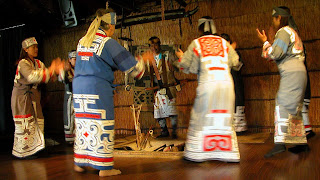
Early Ainu music was associated with festival singing and dancing, and was related with spirit deities (kamui) and animals such as the bear, whale, owl and the sea turtle. The playing of the musical instruments was used in the context of telling epics stories, praying, greetings, magic spells or just for enjoying themselves. Many songs are accompanied by hand-clapping alone, or the singers form a circle or perform a pantomimic dance (e.g. bird dance).
They may use a characteristic form of throat singing called “rekuhkara”: it is like a game that involves two women facing each other, with one forming a tube with her hands and chanting into the mouth of the her partner. The technique is essentially one where the "giver" provides the voice and the "receiver", holding her glottis closed, uses her vocal tract to modulate the sound stream http://en.wikipedia.org/wiki/Rekuhkara
The main styles of Ainu music or chants are epic and narrative songs called yukar and the upopo.

The yukar is a narrative style of sacred songs generally performed by women which use shorter repeated melodies. It may be also heroic epics, being long stories but usually performed by men. The rhythm is kept by clapping the hands or by beating a stick against a wooden hearth that it was used to be found in the traditional Ainu houses.
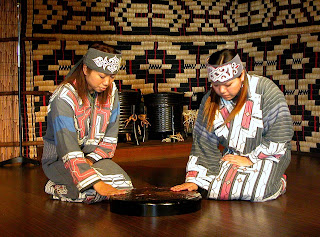
The upopo (seated songs) is a vocalized form of contrapuntal or polyphonic music based on chanting. Many woman are seated in a circle. Placed in the center is wooden chest lid, which the women beat with their hands. They are performed without instruments. When they use musical instruments, such as mukkuri and tonkori (see below), they are related to the daily work, for creating a work rhythm or imitating animal’s calls or raindrops patterns, but also may acted as prayers and warded off evil spirits which may cause diseases (kutunke). Many Ainu tradicional dances are based on rimse (round dance) centering around upopo chants.
They also may sing lullabies (named ihunke and iyonnonkka) using falsetto and rolling the tongue in the mouth.

The sinotcha are lyrical songs, usually sung bu one person, which express ordinary everyday emotions, such as love and happiness.

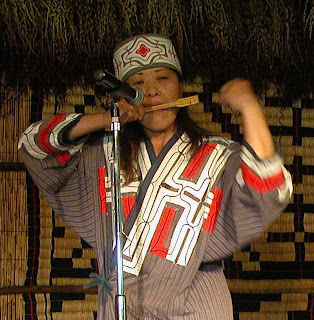
The pictures of the singers, musicians and dancers were taken from a performance in The Ainu Museum in Shiraoi, Hokkaido. For the description of the instruments see the Page of Ainu Musical Instruments in this blog


References:
Chiba Nobuhiro. The music of Ainu. The Ashgate Research. Companion to Japanese Music. A. McQueen Tokita & David W. Hughes eds. Aldershot, Hampshire, England, 2008: 323-344.

Tanimoto Kazuyuki. Regional and Minority Music in Japan. Music of the Ainu, Nivkhi, and Uilta. The Garland Encyclopedia of World Music. Vol 7. East Asia: China, Japan and Korea. Robert C.Provine, Yosihiko Tokumaru and J.Lawrence Wiyzleben editors. Routledge. New York, 2002: 781-788.

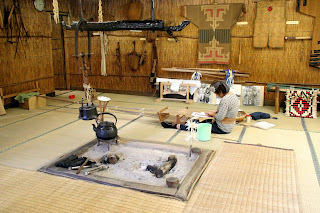
In my visit to Hokkaido I noticed a strong revival of the Ainu culture http://www.japanfocus.org/-Chisato__Kitty_-Dubreuil/2589. I have to thanks to the staff of the tourist office in Yamagata, in the building Central Kajo http://www.yamagatakanko.com/english/index.html, who helped me to plan my travel to Hokkaido. There are so many places to visit in Hokkaido related with the Ainu Culture that is quite difficult to choose. In addition, some of them are a little far for foreign people who are short in time (I'm a catalan from Barcelona, Spain). The woman who kindly attended me, suggested to visit The Ainu Museum in Shiraoi, Hokkaido. To go there, take the train from Hakodate, Hokkaido to Nobosiberetsu (Sapporo Line), and then change train to Shiraoi. It is possible to visit in one day trip from Hakodate.

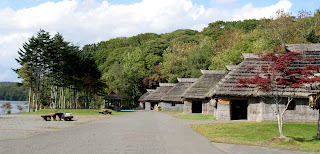
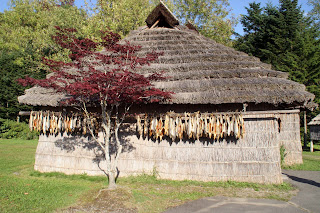
The Ainu Museum in Shiraoi, Hokkaido, it was established in 1976 by the Shiraoi Fundation for Preservation of the Ainu Culture, It is a very interesting because there are a museum and several houses that simulate a traditional Ainu village or kotan. It is placed near the lake Poroto. The museum is also named Porotokotan (Poroto village). It is the largest construction of an Ainu village in Japan. They have about 800 items on display. Also you can see a performance of Ainu traditional musical and dances. Also it is possible to learn to play the mukkuri. They also have a quite complete shop of books and CDs related with Ainu culture. Do not miss the beatiful sunset view from the village towars the lake http://www.ainu-museum.or.jp/.


Altough small, it is very interesting the Hakodate City Museum of Northern People in Hakodate (south of Hokkaido). They do not have shop of books for sell. The have a nice DVD of the Ainu on display.
If you can not go to Hokkaido, in the Ueno Park in Tokyo you can visit the Tokyo National Museum http://www.tnm.jp/ They have a display of about 40 Ainu items. If you visit the touristy city of Kyoto, you can go to Osaka in a round day trip and visit the Osaka National Museum of Ethnology. They exhibits about 500 items http://www.minpaku.ac.jp/english/ . Thought the year is possible to attend to ceremonies, rituals and festivals organized by The Ainu Association of Hokkaido, The Ainu Museum (Shiraoi), The Foundation for Research and Promotion of Ainu Culture (Hakodate, Sapporo), and many other cultural associations.

RECOMMENDED CD COMPILATIONS OF AINU SONGS

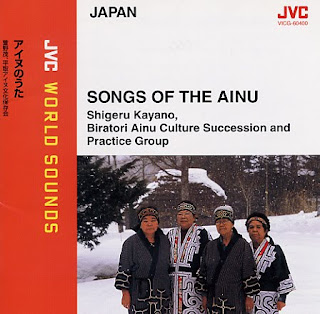
"Songs of the Ainu". Published in the JVC World Sound Series in 2000 the CD. It included upopo and yukar songs as well as dances and lullabies. The singers are Shigeru Kayano and The Biratoi Ainu Culture Succession and Practice Group.


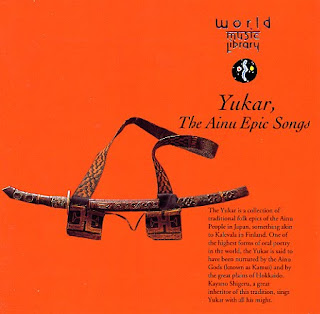
"Yukar, The Ainu Epic Songs". The Excellent Japanese World Music Library (WML) Series published this CD in 1997. It included two long yukar songs: one song is named "A duel with my Guardian God" and the other "Goldend Clogs". It was recorded in Nibutani, Japan. There is extensive english notes Now it's difficult to find. Some of WML albums now are beeing re-edited in Japan with different jackets and sometimes with bonus tracks. As far as I now this CD has not yet been re-edited.


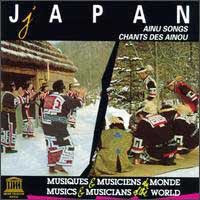
"Chants des Ainou" (Ainu Songs). It is from the Unesco Collection published in 1980 by Auvidis, 1980 France. There are upopo, short yukar songs, some lullabies and dances (rimse), a sinotcha song and other type of ainu songs (one shaman song). The songs were recorded by Kazuyuki Tanimoto and Jean-Jacques Nattiez in 1978 in the villages of Nibutani, Okaribe, Kushiro and Shisunai. This CD is unavailable. Some years ago Rounder Records (Cambridge, USA) re-edited some CDs of the Unesco Collection with completely different jackets. However, they did not released this one.


This last CD I bought it in the Shop of the The Ainu Museum in Shiraoi, Hokkaido. There is no english transcription. There are 31 tracks. Most of them are oral explanations in Japanese. In was published in 2008 by The Japan Traditional Cultures Foundation.

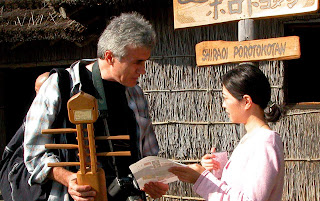
The author with the Manager of the The Ainu Museum in Shiraoi, Hokkaido.

I am very grateful to Nomoto-San and Mizue-San for their help and kindness during my visit to the Ainu Museum in Shiraoi, Hokkaido

MUSICAL INSTRUMENTS OF AINU PEOPLE

The Ainu have very few native instruments, that some of them have similarities with other instruments played in Siberia or South-East of Asia. Howver, the tonkori is an instrument exclusively designed and played by the Ainu people.


CORDOPHONES

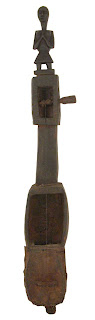
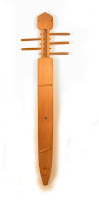
  • Tonkori. It is plucked zither-like string of five strings. It is carved for a single piece of wood. Size may change depending of the maker. It may measure aproximately 120x10,5x3 cm. There are two bridges. Nowadays the strings are the same as in the shamisen. Usually are tuning, respectively, from 1st to 5th string, in F, C, G, D, A. The opening strings-pitches are used. The strings are plucked with both hands playing arpeggios or strumming all the strings together. It was obsolete in the 1970's, but there is a strong revival thanks to the musician Oki (see below). For european ears, the sound would remind a celtic harp.
Tonkori made by Nomoto-san
  • Pararayki. It is used by the kuril Ainu. It has three strings and comes from the russian balalaika.

IDIOPHONES

  • Mukkuri. It’s a jew’s harp made of bamboo. It is similar to other jew’s harps that are played in south-east Asia. It is usually played by woman. It usually measures about 10x1,5 cm. The player vibrate the tongue-like by snapping the attached string with sudden movements of the hand, thus allowing to resonate the sound in the oral cavity. The player usually imitates natural sounds, imagine nature in motion or animals. Nowadays it is very easy to find in Hokkaido since it is sold as a tourist item.

AEROPHONES

  • Straw flutes
  • Pehkutu. reed-stalk pipe
  • Coiled-bark horns

MEMBRAPHONES


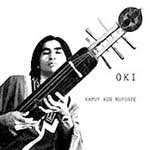
MUSIC OF TONKORI. The most famous contemporary performer of Ainu music is the the revivalist KANNO OKI who plays the tonkori. He deserve the recognition of having approach the Ainu music to the young generation. He has published several traditional CD and have mixed the tonkori with modern instruments and rhythms. His discography is the following:

1. Kamuy kor nupurpe. Released in 1996 and 2001. He adapt Ainu music playing tonkori, guitar and chants to acomplish a rock, reggae and pop nice mix.


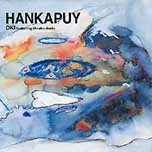
2. Hankapuy. Released in 1999. It the album collaborated the late Umeko Ando and Kazutoki Umezo (with percussion and sax). It could be described as Ainu new-age style-like music.


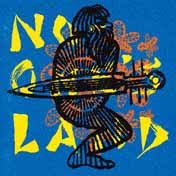
3. No one's land. Released in 2002. He include a femele chorus group. There are influences of reggae, and an spanish and african flavour. Ainu songs and solo tonkori with modern arrangements. Interesting are the throat songs of the siberian singer Olga Letykai Csonka. Some songs of this album were remixed in the Oki album entitled "Dub Ainu", which was released in 2004.


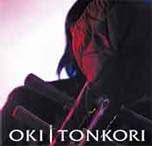
3. Tonkori. Released in 2005. It is almost an instrumental CD of tonkori without additional arrangements. In the album there are traditional Ainu songs (eg. some composed by Umeko Ando, Esohorankemah and several renditions to the tonkori player Ume Nishihira) with three Oki compositions, one of them singing a lullaby. The repetitive and short melodies are peaceful, enchanting and wonderful!!.

Other Oki CD's published as the Dub Ainu Band are the following:
1. Oki Dub Ainu Band. Released in 2006
2. Dub Ainu Deluxe. Follow-up of the previous album. Released in 2006.
3. Dub Ainu Band Live in Japan 2007. Released in 2007

These albums reflect what Oki plays in the live shows: rhythmic phrases of tonkori, bass and percussion with some Senegalese and dub Hirohisa arrangements in some songs.

NISHIHIRA UME (1901-1977) She was one of the last tonkori old players and singers of traditional songs that helped to keep the Ainu Music and traditions during the last century.
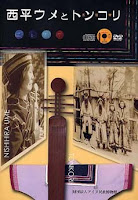
In the The Ainu Museum of Shiraoi I purchased a book where it explains about the Ainus and Nishihira. In the book there are pictures of antic tonkoris and somes tonkoris made by Mr.Nomoto as well as antic pictures of Ainu people and Nishihira Ume holding a tonkori. The book also includes musical scores, field recordings of Nishihira Ume and a DVD explaining how to play the tonkori. The chapter of the tonkori was written by Ms. Miyuki Muraki (Vice-Director of The Ainu Museum of Shiraoi ), Masahiro Nomoto (Curator of the museum), Jirouta Kitahara (Curator of the museum) and Nobuhiko Chiba (professional musician). Ms. Muraki wrote about clothes of Sakhalin Ainu people, Mr. Kitahara explained also about the tonkori and history of Sakhalin. Finally, Mr. Nomoto wrote how to make a tonkori and Mr. Chiba explains how to play the tonkori in the bonus DVD included as well as he transcribed the musical scores. No english translation is included.


THE MUKKURI. One of the most renowed player of the jew's harp mukkuri is the late UMEKO ANDO. She also was a great singer in the upopo traditional Ainu chant. She collaborated in the Hankapuy's Oki album. Pitifully she passed away in 2004. It has been published two albums:

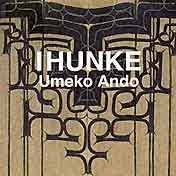
1. Ihunke. Released in 2001. Produced by Oki. The albums is very recommended for its traditional approach with mukkuri and chant songs. Also there are tonkori songs and nice percussion arrangements. It was recorded when she was in her late 60's years-old.


2. Upopo Sanke. Released in 2004. Also produced by Oki who again plays in the album. Ando's chants are complemented with percussion, some mukkuri songs, which become a wonderful album and pleasent music.


All Oki and Umeko Ando albums may be bought thru reliable internet sources such as: the Fisher web page Far Side Music http://www.farsidemusic.com/acatalog/Ainu.html and the Oki Chikar studio web page http://www.tonkori.com. The book of the "Nishihira Ume and Tonkori" can be bought to The Ainu Museum http://www.ainu-museum.or.jp/shop/book.html#tonkori

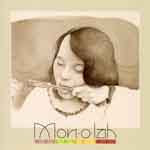
MAGANE AKI. She is a young mukkuri player, born in Hokkaido in 1993. She published thru the Sapporo Cultural Production an introduction to the mukkuri entitled "Sound of Mukkuri, My Sound". The CD "Mon-o-lah" was released in 2001 by http://www.booxbox.com/. It a nice mukkuri album, in which there are very strong mongolian and tuvian influences: horse-fiddle playing (morin-khuur) and mongolian khöömii/tuvian khoomeii throat-singing. When I listen to this CD my mind travel more towards Central Asia or North America than Hokkaido. However, it is really a very nice album!!!. I bought this CD in the Museum Shop of Shiraoi, Hokkaido. However, if you can not go there, it can also be purshased tru the reliable german web page who is specialized in jew's harps named "Danmoi" http://www.danmoi.de.


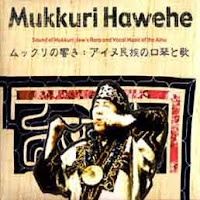
An interesting CD of Ainu jew's harp is "Mukkuri Hawahe. Sounds of Mukkuri Jew's Harp and Vocal Music of the Ainu". It contains 31 songs with a total duration time of almost 56 min. It was produced by Leo Tatagawa in 2001. I met him in 2008 in Abakan, Russia. A very gently guy!!. He is the president of the Japan Jew's Harp Association who has published several jew's harp albums of Siberian musician (Yakutia, Kyrgystan and Khakassia). If you read japanese check his web: http://koukin.jp/. This CD can be obtained directly from Tatagawa's page or thru Danmoi http://www.danmoi.de.