Introduction
Georgia
is a small mountainous country situated in the Caucasus. It is bordered in the
south-west by Turkey and Armenia, in the east by Azerbaijan, in the west by the
Black Sea and in the north by Russia Federation (Karachay-Cherkessia,
Kabardino-Balkiria-Ossetia, Ingushetia, Chechnya and Dagestan).
 |
| Map taken from Lonely Planet web page |
Georgia’s
population is about 5 million. Ethnic Georgians form about 85% of population.
The remaining are formed by ethnic groups from the neighbourhood regions such Abkhazians,
Armenians, Ossetians, Azerbaijanis and Russians; ex -soviet countries such as Belarusians,
Bulgarians, Estonians, poles, and Ukrainians. There also Turks, mainly in the
south, a significant Jewish community and Iranian immigrants.
Despite
the Russian/soviet influence, Georgia has its own non-indo-European language
and its own writing system. It comes from the Kartvelian family group, which
includes Georgian, Svanetian (north-western mountains of Svanetia region), Megrelian
(western regions of Samegrelo and Abkhazia) and
Laz (in south coast of Black Sea).
Georgia adopted the Christianity in 337, and
large majority of Georgian population is Christian Orthodox. There are also
small communities of Georgian, Jews and Muslims (near the Azerbaijan border). During
centuries many churches has been built.
The Bagrati Cathedral, the Gelati
Monastery and the medieval religious monuments of Mtskheta are in the list of
Unesco World Heritage list.
 |
| Gelati Monestery |
 |
| Inside de Gelati Monastery Chruch |
 |
| Mtskheta Cathedral |
Tbilisi is the
capital of Georgia. The old town is very pleasant and it can be
visited on foot. The Matkvari river cross the city giving delightful sights
from Meidan bridge. It is still possible to see old houses with nice balconies,
beautiful small lanes and many cafes and bars in the pedestrian Erekle II and
Sharden streets. You can start to walk down from Rustaveli to Betlemis squares.
The main sights in Tbilisi are the Tsminda Sameba Cathedral, Metekhi Church,
Nariqala Fortress, Sioni Cathedral and the Museum of Georgia.
 |
| Tbilisi |
The
Georgia highlights near Tbilisi (one day trip) are the Jvari Church and,
Svetitskhoveli Cathedral in Mtskheta and the Uplistsikhe pre-Christian temple
caves near Gori.
To the east at one-two days trip you can find the Bodbe Convent near the nice small town of Sighnaghi and the interesting Davit Gareja complex of old monasteries near the Azerbaijan border in the beautiful desertic and remote place. Near Telavi you can visit the Alavardi cathedral and the Gremi citadel.
To the north in one day trip you can visit Ananuri church, Geregeti Semeba Monastery, Gori with the Uplistsikhe caves.
 |
| Gerati Semeba Monastery |
To
the west at about 4 hours trip there is the second large city of Georgia:
Kutaisi. The most interesting is the Bragati Cathedral and at 6 Km the
wonderful Motsameta monastery and at 9 Km from Kutaisi the impressive Gelati
monastery complex.
 |
| Gelati Monstery |
If you have time, don’t miss Svanetia region! To reach the
town of Mestia you will pass a spectacular road with small towns such Lenjeri.
 |
| Inside the small church of Lenjeri |
I
recommend sleep at least one or two nights in Mestia to visit the small
villages with the koshkebi, or defensive towers built between 9-11th
Centuries.
 |
| Village around Mestia |
 |
| Villagea around Mestia |
 |
| Koshkebi (defensive towers) |
The remote town of Ushguli, at 2100 m above the sea level, is a 47
Km from Mestia. The road is unpaved. It has many Svan towers and it is on the Unesco World Heritage
list.
 |
| Ushguli |
Art-Gene
Festival. This festival is held every year on July. It usually plays Georgian
groups, but also from other European or Asian countries. It is complemented
with dances, theatre and children’s activities.
There are exhibitions and sales of traditional arts, crafts and food. It
takes place in the Open-Air Museum of Ethnography, at the south-west of the old
town. http://www.artgeni.ge/
There are many wooden houses from 14
ethnographic areas from Georgia and exhibitions of different kinds of ethnographic
tools, rugs, and ceramics.
State
Museum of Georgian Folk Songs & Musical Instruments. (Address: 6 Samgrebo
St). It is a small museum, centrally located in the old town, with three rooms
where you can see all the musical instruments commonly played in Georgia, but also
from Azerbaijan and some European countries. There are nice old pictures of
Georgian and Azari musicians The museum was created on the basis of AV Revazishivili's collection of musical instruments in 1975. A nice guy made me an explanation in English of the instruments on display. An interesting short video coud be also seen. This small museum is highly recommended!
http://www.openmuseum.org/webpage/show/1191
http://www.openmuseum.org/webpage/show/1191
 |
| Inside of the Museum. Azari instruments |
Near the entrance of the museum there is a small shop of musical instruments, in which there are several used instruments on display and very few instruments for selling, such panduries and salamuries. The seller doesn’t speak English.
Learn
to sing and to dance in Lenjeri. In the nice and small town of Lenjeri in Svanetia region,
two km from Mestia, components of the Riho Ensemble organizes singing and
dancing classes for several days. Sleeping and foot is provided. Singing
classes are given by the director of the Riho Ensemble and his son, Islam and
Vekhatang Pilpani, and dancing classes are given by Archil Murgvliani. If you
are interested how to sing vocal polyphonic songs you have to go and you will
be very welcomed. In this town you will also see the typical koshkebi or
defensive towers of this región. During my visit to Mr.V.Pilpani, there was people from Canada, US, Australia and other countries, which were taking lessons of singing and dancing.
https://www.facebook.com/vakhtang.pilpani
https://www.facebook.com/vakhtang.pilpani
 |
| Mr. Islam Pilpani |
 |
| Islam &Vekhatang Pilpani, with a changi |
 |
| Dancing class with Archil Murgvliani |
 |
| Archil Murgvliani |
 |
| Vekhatang Pilpani & Blog author |
MUSIC OF GEORGIA
Traditional
music is well preserved specially in the mountainous areas. Polyphonic singing
of Georgia has been included in the World Heritage of Humanity by UNESCO in
2001.
 |
| Singeres in a wedding in Motsameta Monastery |
Polyphonic Vocal Singing. It is very charactherisc of Georgia. Male choirs may use two, three of four part singing polyphonies depending on the region with different styles. The most common is the three part form: top, middle and bass voices. The bass voice use to be the chorus, the middle voice is the soloist part and the top use to be the second voice. It is characteristic the improvisation and competitive spirit. Polyphonic songs are used in working, drinking and wedding events. They are also used in masquerade performances, rituals laments or religious celebrations. There are also liturgical and funeral polyphonic songs. Vocal polyphonic songs may be sang acappella or accompanied by the pander. In Samaria may by also accompanied by the change and circle dances. Lullabies are mainly sang by a single woman accompanied by the chonguri. In Georgia you can easily found by chance a vocal choir singing in a church, in a wedding o around a table.
Recommended
CDs
There
are very few CDs available in the international market, many of the have been
released in France, and some of them are out-of-print. Below I list some the I recommend.
Riho
Ensemble. Vocal Polyphonies from Svanetia.
Inedit, France. Highly recommended. Choral singing directed by Islam
Pilpani. The group sings epic, ritual, religious songs. Some of these songs are
used for round dancing. Few songs are accompanied by the chuniri and changi. It
was recorded on 1999 in France.

Folk
Music from Georgia Today. Wergo, Germany, 1993. Twenty six traditional by three
different ensembles: Solnari, Mtiebi and Mzetanze. Recorded on 1991 in Berlin, Male
and Women Choral songs, some accapella, with panduri or dholi. Some songs with
the wind instrument named duduk.

Rustavi
Choir. Georgian Voices. Anthology of Georgian folk songs, 1991 Nonesuch
Explorer Series. Recordings from Melodiya Records between 1981 and 1988. The
artistic director is Anzor Erkomaishvili. Several styles and types of songs are
included: work, laments, table, and sacred songs. Rustavi Choirs is one the
most famous. They have recorded many CDs in various labels.

Rustavi Choir & Duduki Trio Omar Kelaptrishvili, 1991 Musik Network

Kolkheti
Ensemble. Shavtvala Gogona, Pan, Netherlans, 1992. Popupar male choral group.
The director is Givi Shanize. Traditional songs recorded in Tbilisi in 1988 and
1989.

Pan Records other albums such as the female singer Lela Tatarasidze, Jangui Morning fog, 1999 and The Golden Fleece. Songs from Abkhazia & Adzharia, 1994
Pan Records other albums such as the female singer Lela Tatarasidze, Jangui Morning fog, 1999 and The Golden Fleece. Songs from Abkhazia & Adzharia, 1994
.jpg)
Tsinandali
Choir. Table songs of Georgia. Real Word, UK, 1993, Ensemble from eastern
region of Georgia, Kakhetia. Ten table songs recorded by Melodiya in 1988 and
released internationally by Real World. Arrangements by Levan Abashidze.

Songs
of Survival. Traditional Music of Georgia, Topic , 2007. 2CD compilation album
by the UK based label and compiled by Michael Church. Fifty one songs of
several artists and a complete inner booklet. Highly recommended.

Ensemble
Mze Shina. Ushba. Polyphonies of Georgia. Buda Musique,
France, 2012.
Vocal
Polyphonic French quartet who sings traditional Georgian songs since 1997.

The
Shin. For those who want to explore a different kind of music, I recommend this
trio. It is a progressive
folk/world fusion group founded in 1998 by Zaza Miminoshvili (guitars,
panduri), Zurab J. Gagnidze (electric and acoustic bass, vocals) and Mamuka
Gaganidze (vocals, percussion). The trio is based in Germany, they are well
known around Central and Eastern Europe because of their regular live shows (usually
with different guest folk and jazz musicians, dancers, etc. They have released
several albums: Tseruli, 1999, Ibero-Caucasian style, 2003; Many Timer, 2004;
EgAri, 2006; and Black sea fire, 2009. Highly recommended.
http://www.progarchives.com/artist.asp?id=5505
http://www.progarchives.com/artist.asp?id=5505
Vertkov
K et al. Atlas of Musical Instruments of the Peoples Inhabiting the USSR.,
State Publishers Music, Moscow, 1975. In Russian. Some parts with English
translation. Out-of-Print.
Jordania
J. Georgia. The Garland Encyclopedia of World Music. Volumen 8. Europe. Garland
Publishing, Inc. Taylor and Francis Group. London, UK, 826-849, 2000.
Georgia, Armenia & Azerbaijan. Lonely Planet
Georgia, Armenia & Azerbaijan. Lonely Planet
Interesting
links:
Wonderful
page of Levan Bregvadze. There are many great pictures of folk musical
instruments of Georgia with explanations of how to tuning them. Many songs may
be listen to online of groups such
Rustavi, Umuli, Adila, Lashari, Georgika and others.
http://www.adila.ge/.
Page of the Ensemble Adile and the choirmaster and musical instruments maker Maizer Gazdeliani. They have released two albums.
Page of the Ensemble Adile and the choirmaster and musical instruments maker Maizer Gazdeliani. They have released two albums.
http://www.polyphony.ge/uploads/simposium/eng2/shilakadze_chonguri.pdf.
An article of Nanana Shilakadze about polyphony and the chonguri.´
An article of Nanana Shilakadze about polyphony and the chonguri.´
 |
| Musician with a panduri |
Knowledgements; To Mr.Levan Bregvadze and Mr. Vekhatang Pilpani
for their help, information and kindness.
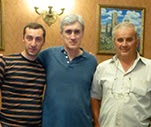 |
| Mr.L.Bregvadze, Blogg author, Mr.M.Gazdeliani |
 |
| Mr. Vekhatang Pilpani and Blogg author |


-1-Blog.jpg)


.JPG)


